
THE PASSIONATE JOURNEY OF Alessio Boschi

|
I first met Alessio Boschi about a decade ago, when he served as creative director for an important jewelry company. His designs, using colorful gemstones and pearls, exhibited a level of originality, detail and ingenuity rarely seen in today’s world of fine jewelry. Over the years, I have followed his career, and am still in awe of his talent and creativity. Let’s take a brief look at the Passionate Journey of this extraordinary artist. By Cynthia Unninayar |
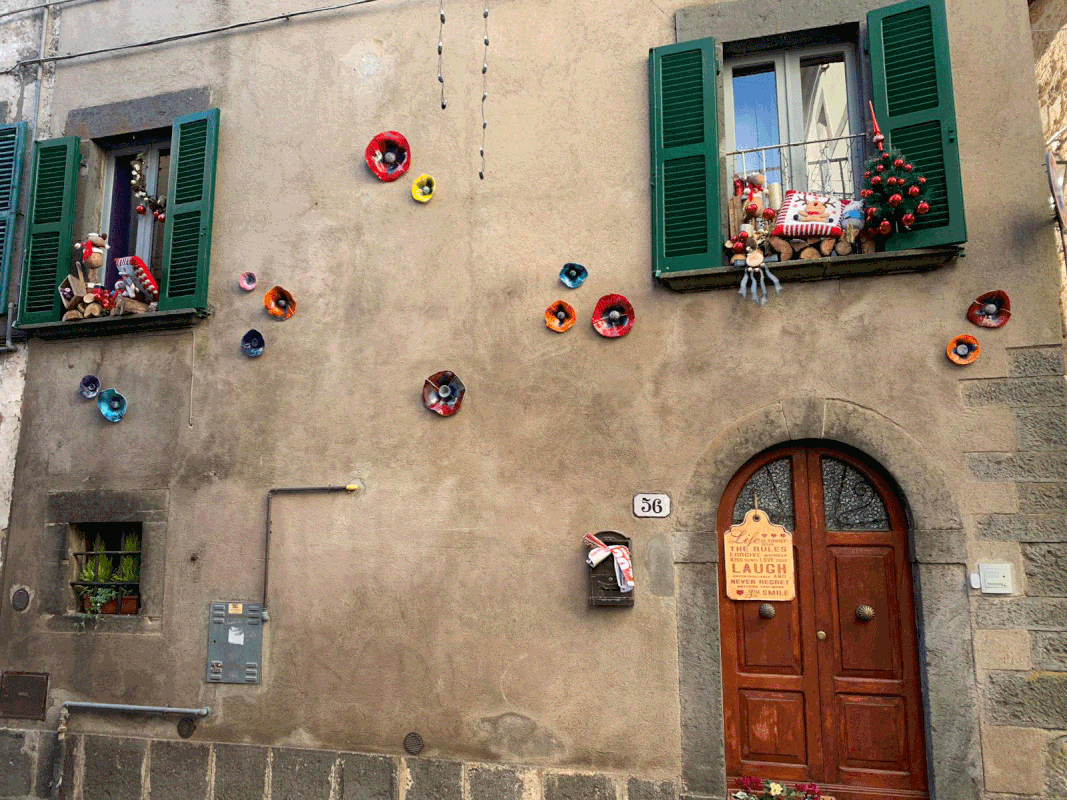
The outside of Alessio Boschi's Italian home, with parts dating back to the 15th century.
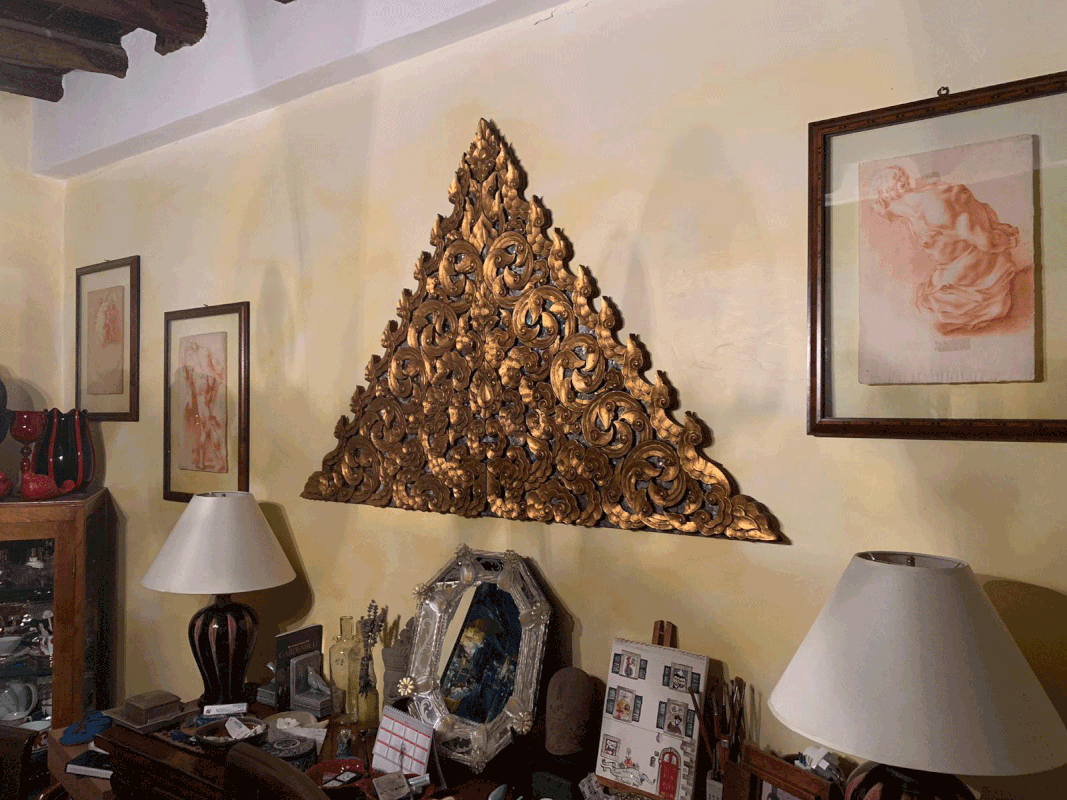
Among the many objects from around the world decorating Alessio Boschi's "ancient" Italian home are sketches by the prestigious 17th-century family, i Ligari, ancestors of Alessio Boschi.
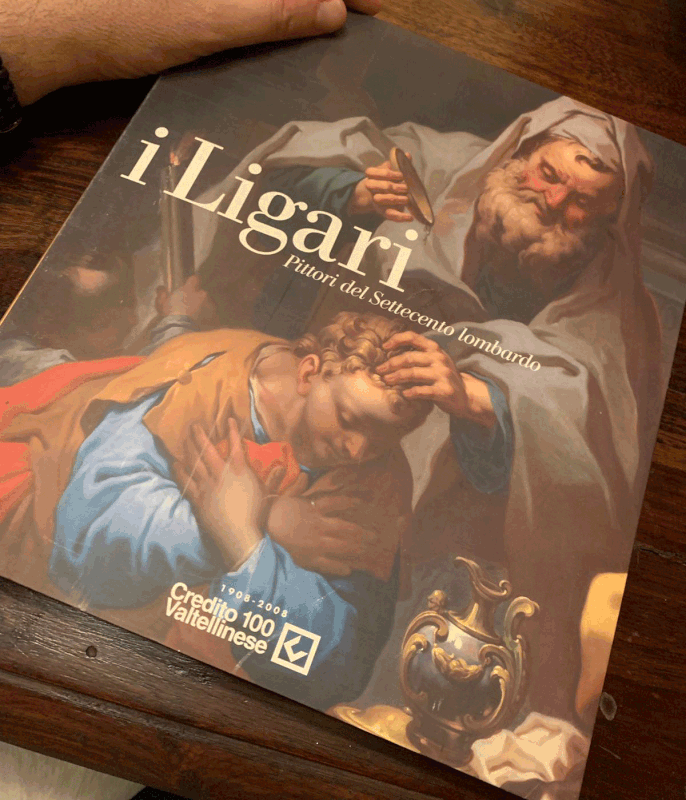
A book about members of the i Ligari family and their work.
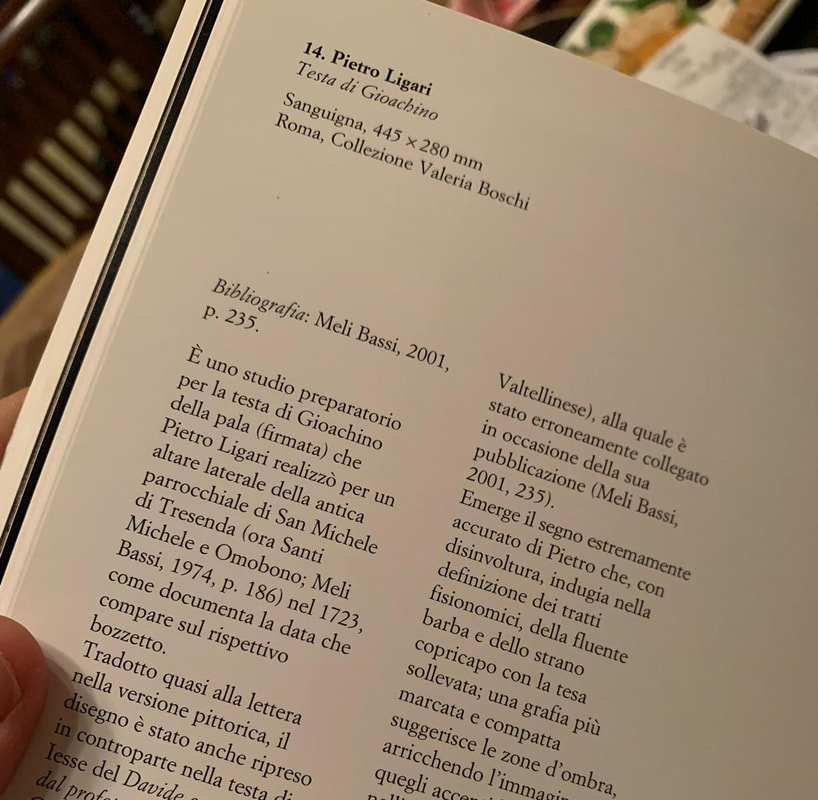
Among the sketches by i Ligari mentioned in the book are those owned by Valeria Boschi, Alessio's sister, and Carlo Boschi, Alessio's father.

Alessio Boschi and his sister Valeria Boschi, an invaluable part of his business.
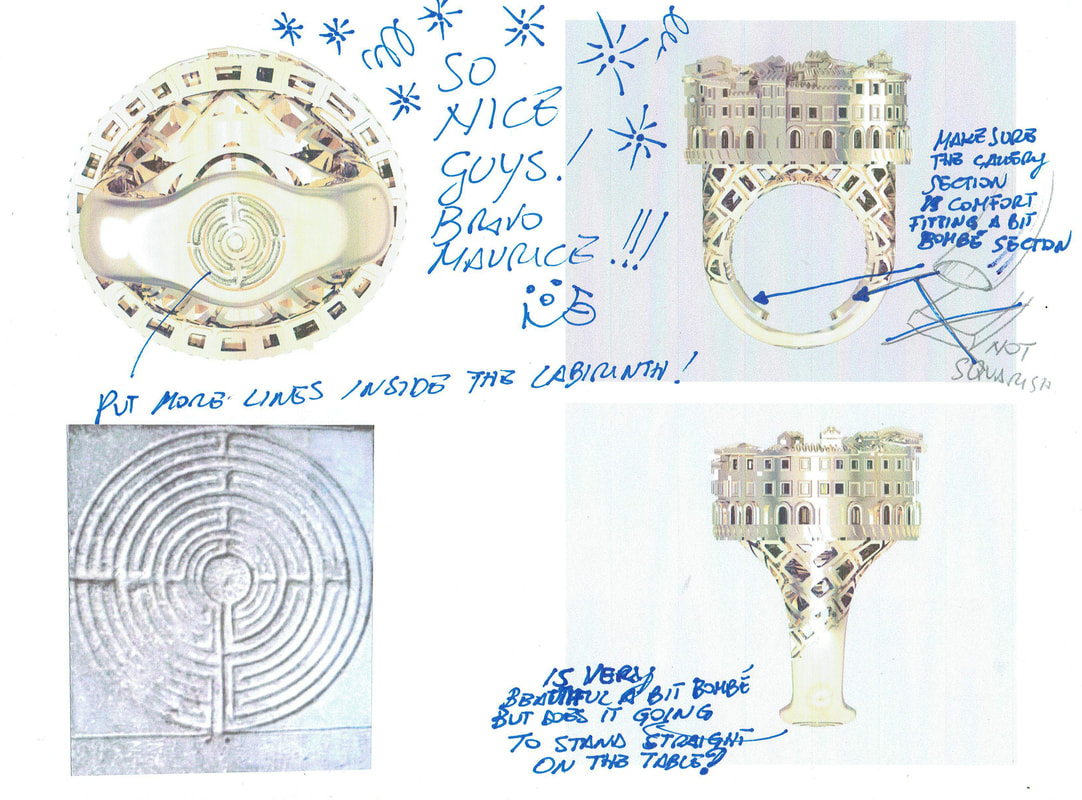
Sketch of the design process in creating and producing the "Coliseum" ring, part of Alessio's "Grand Tour of Italy."
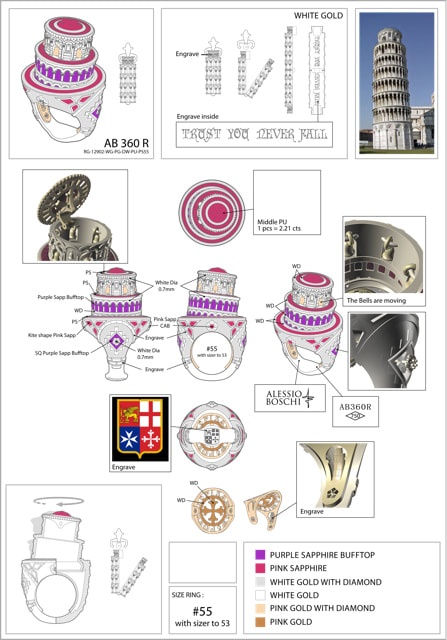
Schematics and notes on the details that go into designing the special mechanisms and details of the Pisa Tower ring.
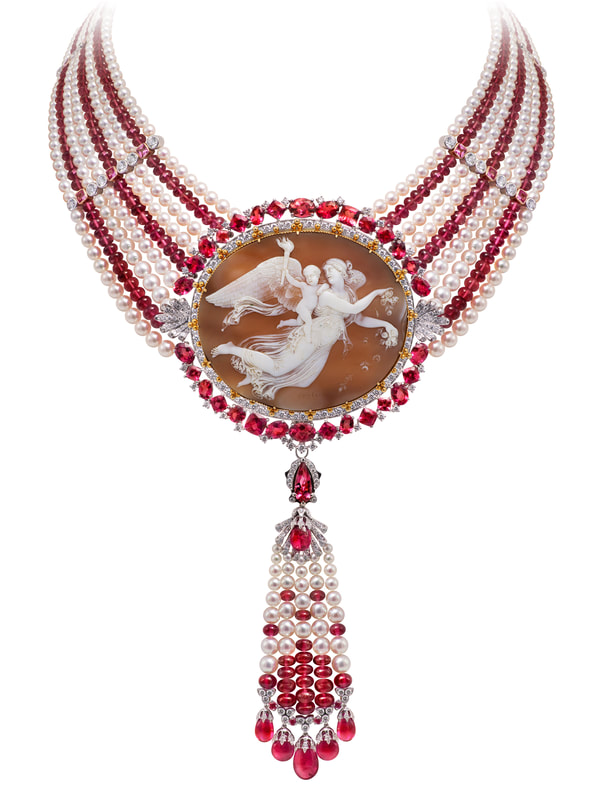
The “Angelo del Mattino” necklace, features a cameo carved in 1850 by famous Roman artist Saulini, accented with rubellites, diamonds and akoya pearls. A hidden system behind the removable cameo allows a view of Michelangelo’s ‘Night and Day’ at Florence's Medici Chapel of San Lorenzo. The tassel can be worn alone as a pendant.
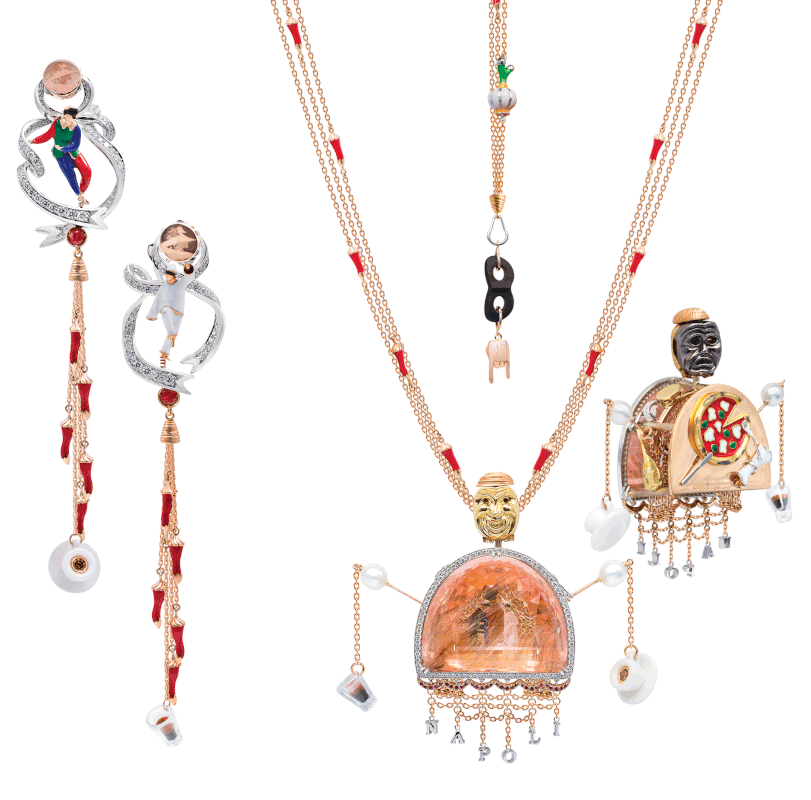
“Bella Napoli” necklace and matching earrings celebrate the traditions of Neapolitan life—food, coffee, theatre, music, dance and more. In morganite, enamel, and precious gems, the black rhodium spots suggest a burnt pizza crust coming out of the wood-burning oven. The morganite was cut to evoke a theatre stage, with chain curtains that can be pulled back to reveal characters from the Commedia dell’Arte, with the comedy and tragedy masks in gold and enamel crowning the arch of the pendant.
|
As you step over the threshold into the home of Alessio Boschi, among the first things that command attention are sketches by the famous 17th-century family of artists, i Ligari. Clearly, the artistic genes of this remarkable family have passed down more than four centuries to flourish today in one of the world’s most passionate and creative jewelry designers.
Given his celebrated ancestors, it was only natural that Alessio Boschi would choose to live in a home that reflects his Italian heritage. Located in a medieval village in the Latium region, which makes a triangle between Tuscany, Umbria and Rome, it is not far from the famous Civita di Bagnoregio, an ancient town seemingly suspended in the sky. Alessio’s house is also “ancient,” with parts dating back to the 15th century. “In 2005, I had the chance to purchase this property, which needed a lot of work,” notes Alessio. “During restoration, we discovered that the basement—which was originally used to house animals—dates back to the 15th century. The main floor is 300 years old and the top floor is 150 years old.” In excavating the basement to make it livable, architects found pieces of Renaissance ceramic and two arches made of large stones, indicating that the original owners had a certain standing and wealth. “In the Tuffs Caves underneath the house, you can see the strata of lava flows over the centuries,” he adds. “Today, the house is a magical place and full of positive energy.” If we turn the clock back a few decades, Alessio began life in Rome in a house built in the early 20th century. He was a precocious child, creating simple designs in jewelry when he was only five or six. At seven, he developed a real passion for jewels after visiting an archeological museum in Athens with his mother. But life was not easy for the young boy. “I suffered from the divorce of my parents,” he recalls “and retreated into my own world of design and Nature. These were my safe zones.” In his late teens, he attended the Accademia di Costume e di Moda in Rome where he received a Bachelor’s degree in jewelry design. Before long, the young designer was entering international competitions and winning many prizes for his unique designs. After graduation, and to perfect his craft, Alessio worked for various companies in Greece, Milan, Bangkok, Hong Kong and Australia. The accolades for his work began mounting and, by 2013, he had been recognized with more than 28 awards from worldwide competitions for his original creations. He then decided to move back to Bangkok and establish his own company, AB Jewels. His sister Valeria joined him in this bold venture. “She is invaluable to me and the business,” smiles Alessio. While most production is done in Bangkok, where he oversees a highly skilled team of talented artisans, Alessio returns to Italy as often as he can. “It is a good place for inspiration, and I feel close to Nature and the amazing history of Italy.” This closeness to Nature and history is undoubtedly the driving force for taking a journey back in time to tell passionate stories using jewelry. Amazing examples of this storytelling can be seen in collections such as Historica, Naturalia and Thalassa, among others. There is also a whimsical side to Alessio’s creativity as seen in the Surprise Me lines. Multi-functionality is also important to Alessio and make up parts of his collections, with interchangeable rings, earrings, brooches, pendants and more. The designer has a preference for organic, curved lines rather than sharp edges, as well as color. “In multiple shades or contrasting tones, color reminds me of the versatility and depth of life and emotions.” And while a brief glance at any Alessio Boschi piece will capture its beauty, time must be spent to understand it, to decipher its messages, to grasp the uncompromising genius behind it. The core of his work involves great attention to detail and a myriad of little surprises. Since the jewelry is so intricate, the details are often missed unless they are pointed out. Alessio’s creations are also known for their ludic elements, their hidden compartments and articulations, which suggest an imaginary journey in a playful way. “I love to hide small surprises in my pieces,” he smiles, “where different stories are concealed in the settings and galleries and offer a different dimension. I want my creations to spark curiosity and guide the wearer on a whimsical journey full of discoveries where nothing is ordinary.” “The Historica collection is a glimpse into a luxurious past,” he explains, “highlighting intriguing stories and people from the rich history of Europe, the Middle East and Asia.” Some of the pieces feature intricate architectural motifs while others offer age-old jewelry techniques to bring personalities to life. He has also taken an inspirational “Grand Tour of Italy" with jewels evoking daily life in Naples, the Tower of Pisa, Rome’s Coliseum, the gondolas of Venice, Verona (Romeo and Juliette), along with the architectural details and stained glass of the famous Milan cathedral and other important Italian churches and monuments. His more “worldly” travels speak to the delicacy of Versailles, the bold colors of Rajasthan and the geometric and floral patterns of the Moghul era, along with so much more. The latest creation in the Historica collection is the “Angelo del Mattino” necklace/collar, with matching earrings. In 19th-century Empire style, taking fashion cues from Josephine Bonaparte, with a touch of Georgian and Victorian influences, the necklace holds a rare cameo carved in 1850 by the famous Roman artist Saulini. Inspired by Thorvaldsen’s famous bas-relief of the day, Saulini’s cameo is surrounded by diamonds and rubellites and supported by 18 strands of pink akoya pearls and rubellite beads. “The dangling tassel can be removed and worn as a pendant, while a hidden system behind the removable brooch-cameo allows a view of Michelangelo’s ‘Night and Day’ at the Medici Chapel of San Lorenzo in Florence,” notes Alessio. One of the recent masterpieces in the Historica collection is the “Bella Napoli” necklace that celebrates, in extraordinary detail, the colorful traditions of Neapolitan life—food, coffee, theatre, music, dance and more. Crafted in morganite, enamel and other precious gems and metals, it even includes black rhodium spots that suggest a burnt pizza crust after it comes out of the wood-burning oven. The morganite was specially cut to evoke a theatre stage, with chains as curtains that can be ingeniously pulled back to reveal Pulcinella and Arlecchino from the Commedia dell’Arte, with the comedy and tragedy masks in gold and enamel crowning the arch of the pendant. Another new addition is the “Peacock Dance” collection that evokes the architectural, decorative and artistic elements of the natural habitat of the peacock—India. The name derives from the traditional Asian dance mimicking the mating dance of this beautiful bird that is performed in southern China, India, Bangladesh, Indonesia and Sri Lanka. “My inspiration was drawn from the peacock’s vivid iridescent plumage, as well as the architecture of Rajasthan’s palaces and forts where the birds roam freely.” 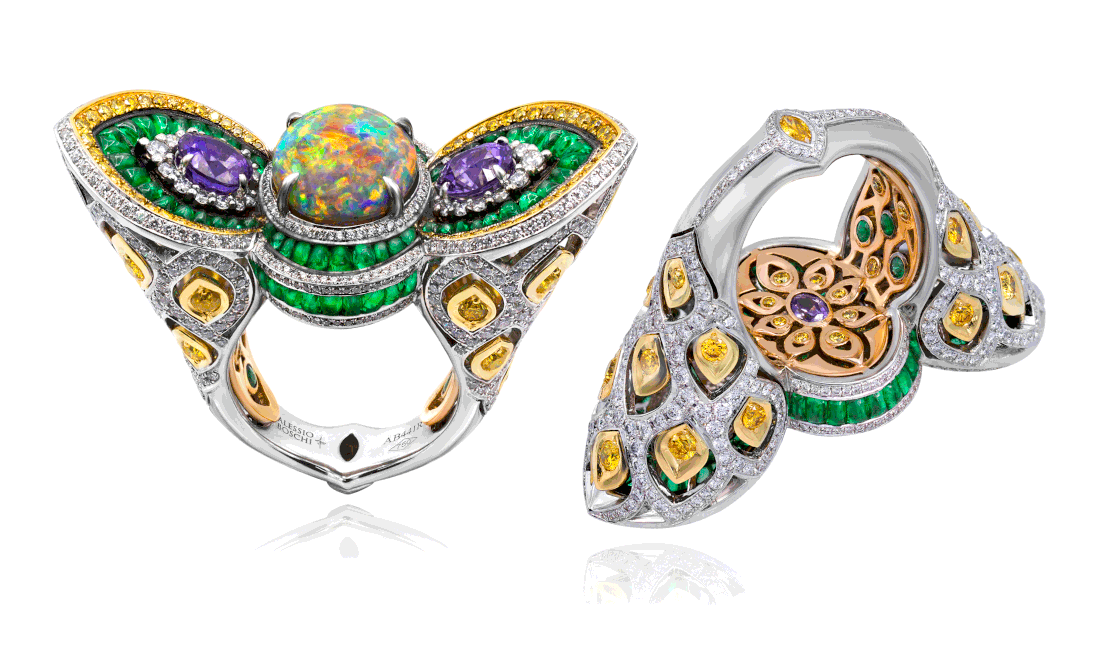
Inspiration for the “Peacock Dance” jewels in the Historica collection came from the bird’s iridescent plumage, captured in vivid gemstones in 18K gold, set against a backdrop of architectural and decorative elements found in India, the bird's natural habitat.
|
|
The bold yet delicate colors of Nature come to the fore in the Naturalia collection. “Nature’s palette is so vast that inspiration is endless,” says the designer, “and it gives me the opportunity to focus on the beauty of flora and fauna, as well as physical phenomena such as erupting volcanoes, exploding stars, blue glaciers, stunning sunsets and more.” Whimsy also delights in a series of delightful rabbits, birds and other animals, crafted from baroque pearls and colorful gemstones.
On the floral side of Naturalia is the remarkable “Rose de France” suite. It pays homage to Queen Marie Antoinette and her love of a special hybrid rose that was created in her honor. Alessio immortalizes these delicate flowers, en tremblant, in more than 101 carats of natural unheated spinels, ranging from purple to fuchsia to pink and even blue, set on petals of pink sapphires, Paraiba tourmalines and yellow diamonds. Leaves in indicolite and aquamarine complete the garden of color. “The detachable dangling parts and clasp can be removed and worn as brooches, pendants or earrings with a separate rose-engraved butterfly,” adds Alessio. |
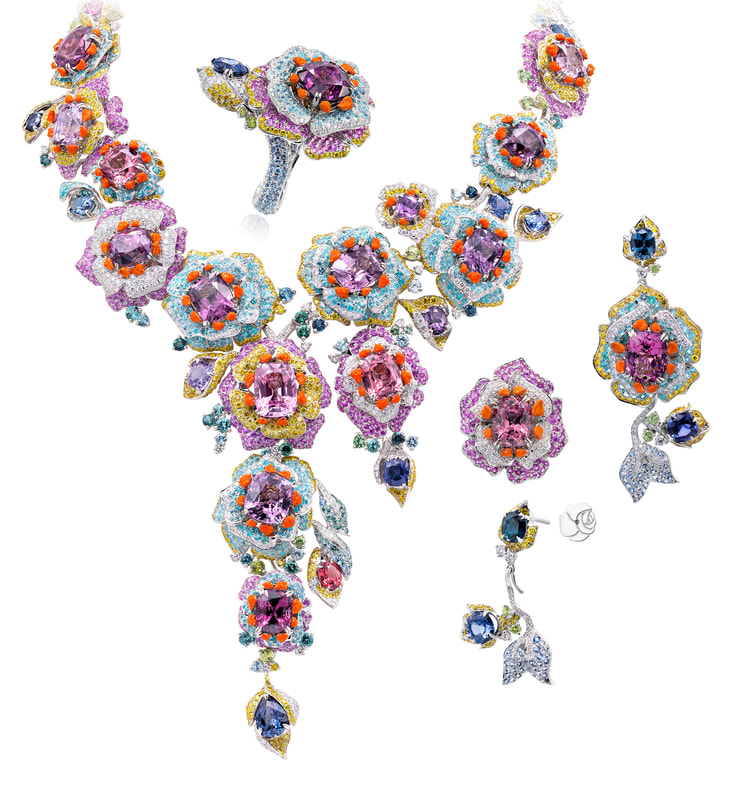
Paying homage to Queen Marie Antoinette, the floral side of the Naturalia collection is seen in the magnificent “Rose de France” line. The flowers, en tremblant, feature more than 101 carats of natural unheated spinels, set on petals of pink sapphires, Paraiba tourmalines and yellow diamonds. The leaves are composed of indicolite and aquamarine. This image shows the versatility and transformability of the set.
|
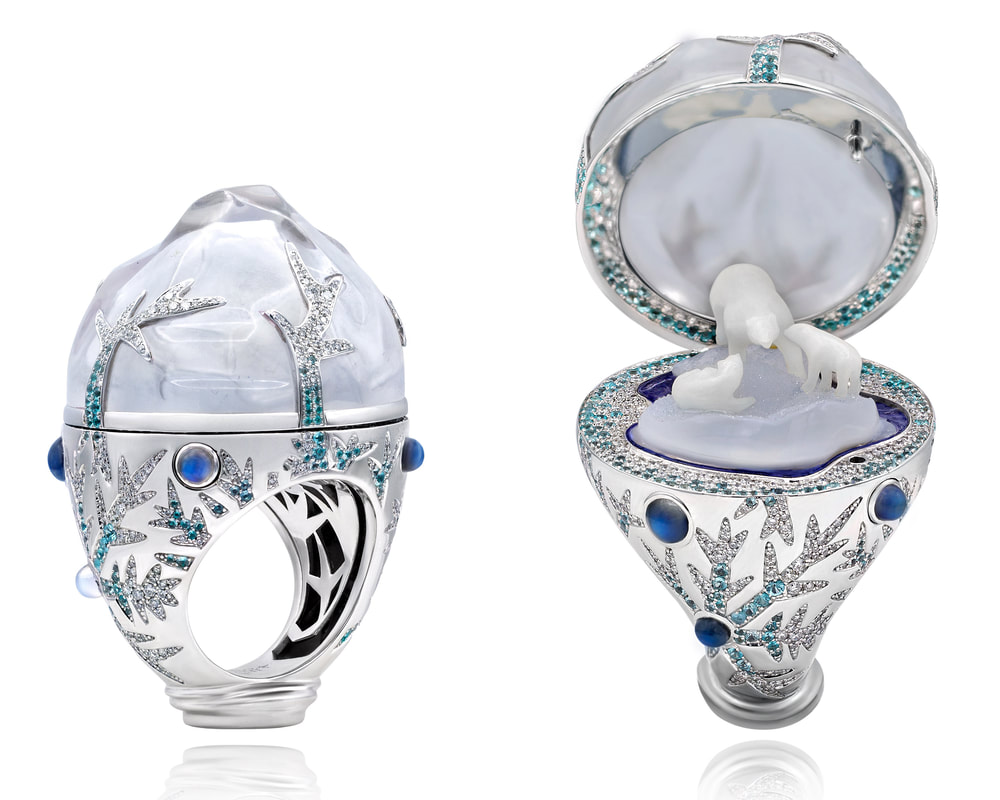
Illustrating Alessio Boschi’s concern for climate change and the plight of the polar bear is this ring that was featured in Vogue Italia’s “The Protagonist” exhibition of sustainable fine jewelry at a Christie’s event in New York City in December 2018.
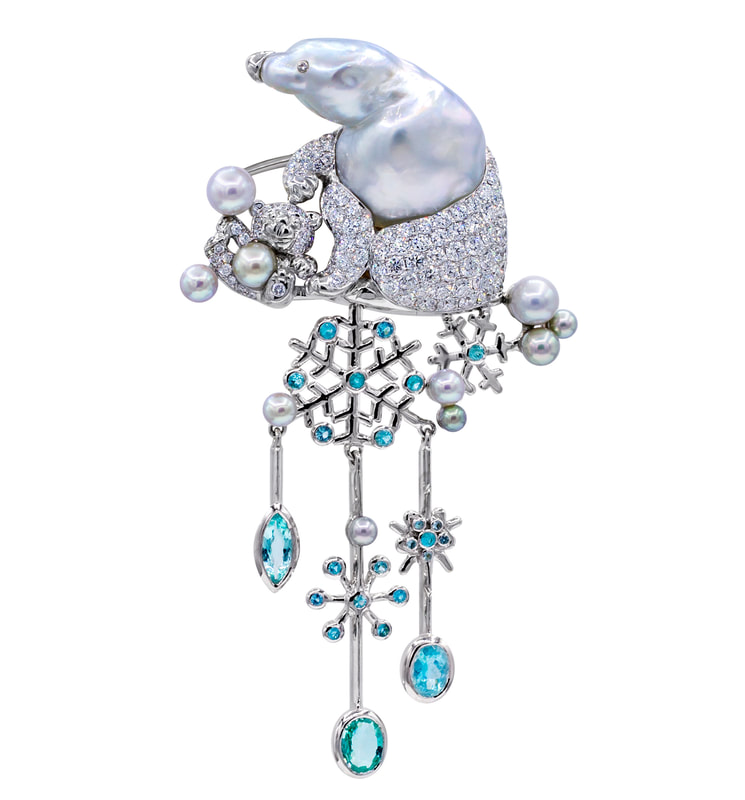
A favorite theme of Alessio is the polar bear, evoking his concern for the planet's changing climate. This brooch is crafted in pearls, diamonds and Paraiba tourmaline
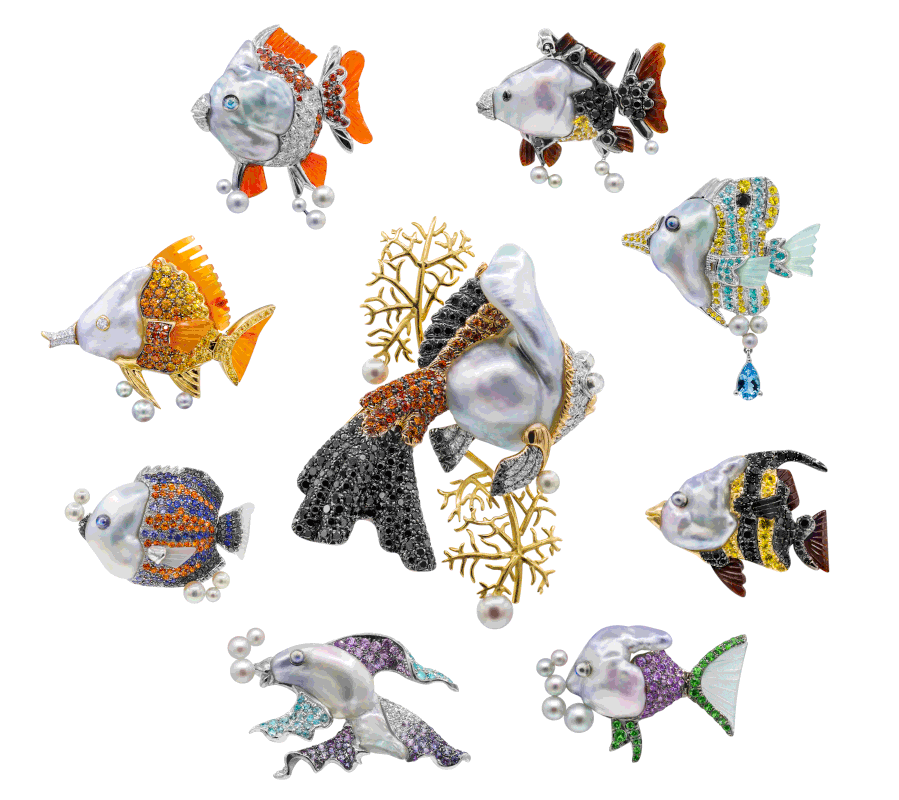
In the Thalassa collection, baroque pearls inspired a series of fish and other marine creatures embellished with gemstones and diamonds set in 18K gold.
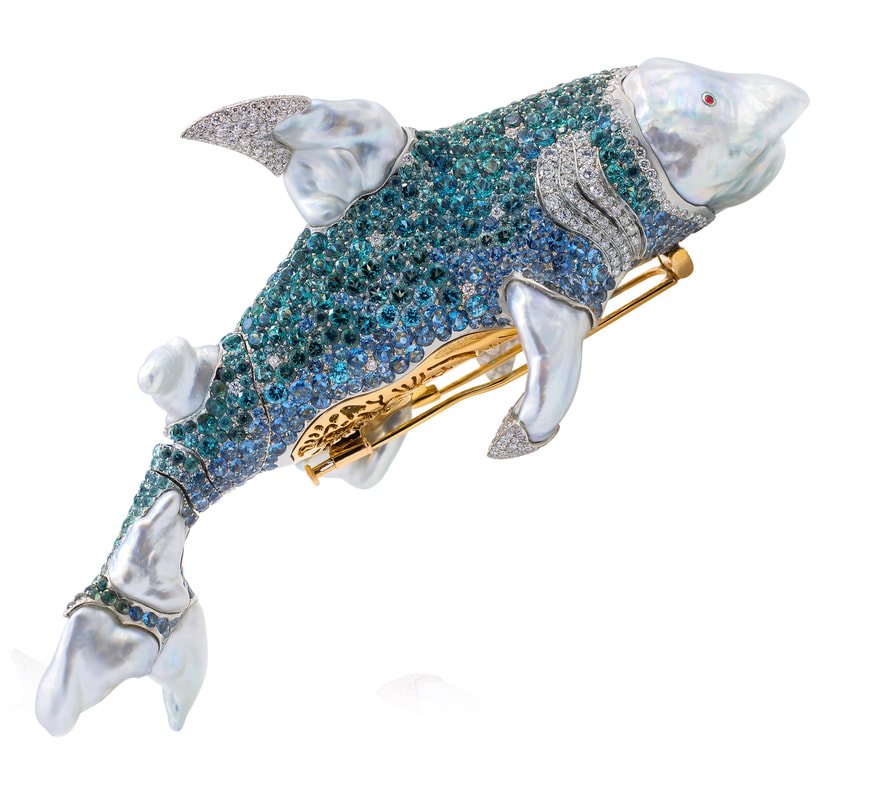
The designer’s “activist” side is seen in the "Great White Shark" brooch, in the Thalassa collection, which he hopes will bring attention to the devastating practice of shark-finning that is destroying these magnificent creatures around the world.
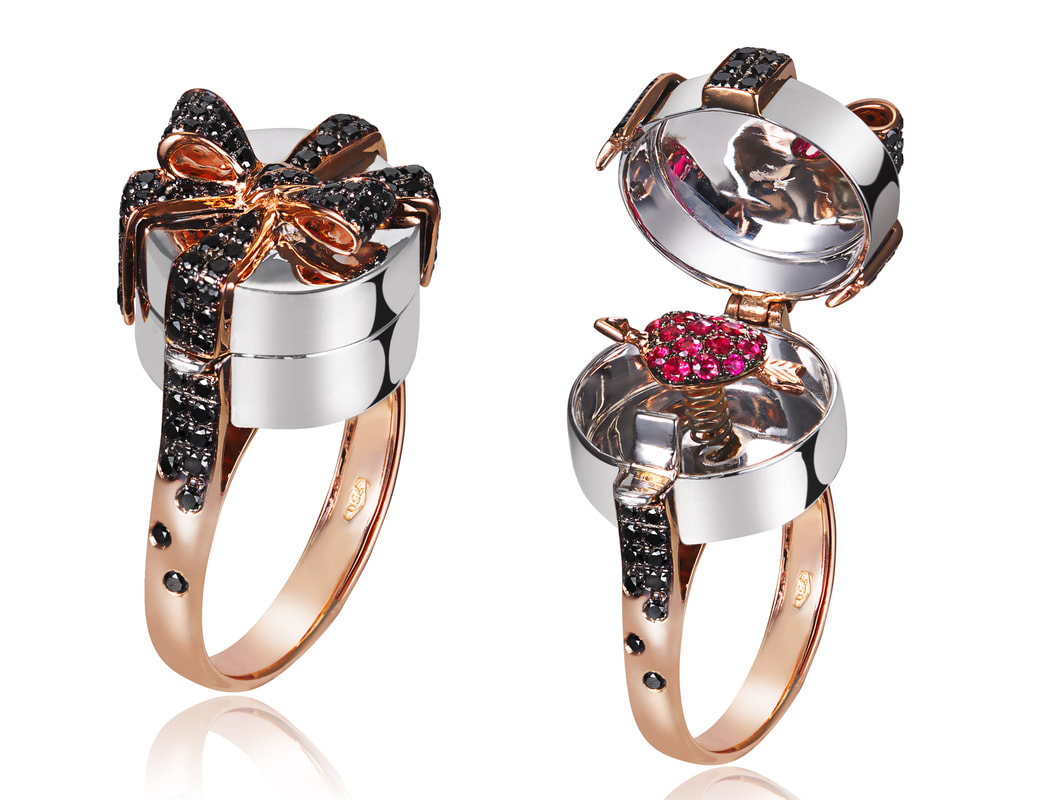
On a more whimsical note, the "Surprise Me" collections offers a variety of rings, pendants and earrings, depicting different shapes of gift boxes in 18K gold embellished with gemstones and diamonds. With a push of a button the boxes pop open, revealing a message en tremblant.
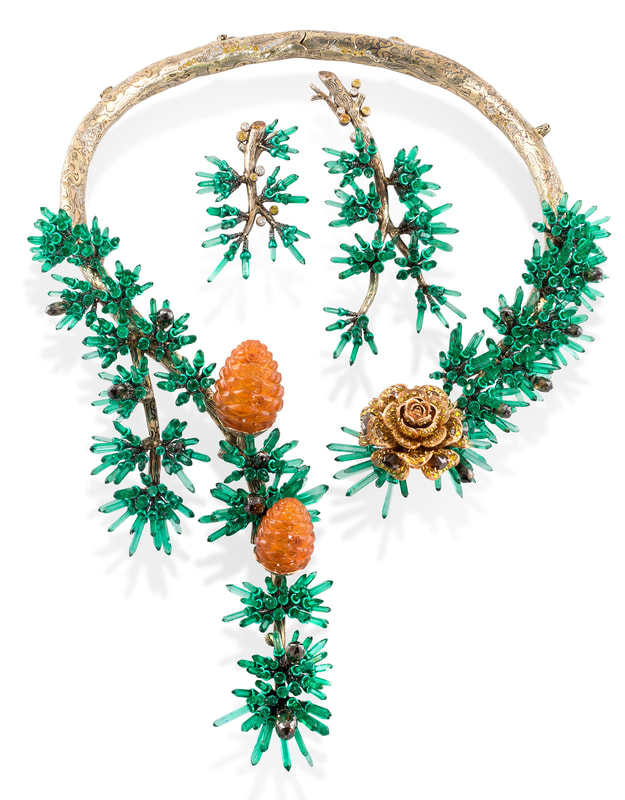
“The Cedar” necklace and earrings is an extraordinary combination of art and technology. Emerald crystals make up the mobile pine needles and specialty-cut spessarites combine to create the pinecones. LED lights illuminate the needles, and the “bark-like” branch is made from the Japanese mokume-gane metalworking technique.
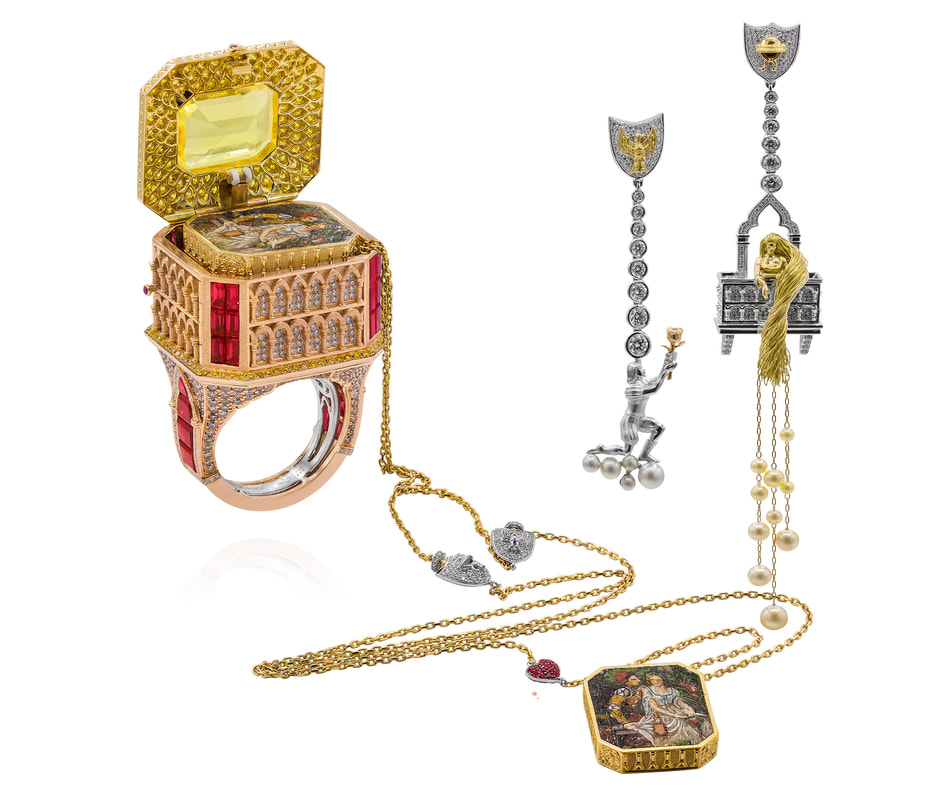
Among the portrayals of Romeo and Juliet are these earrings in gold, diamonds and pearls, with matching ring featuring a micro-mosaic of the ill-fated lovers, which can be removed and worn as a pendant. The micro-mosaic was specially commissioned by Alessio from some of the world's most accomplished micro-mosaic artisans.
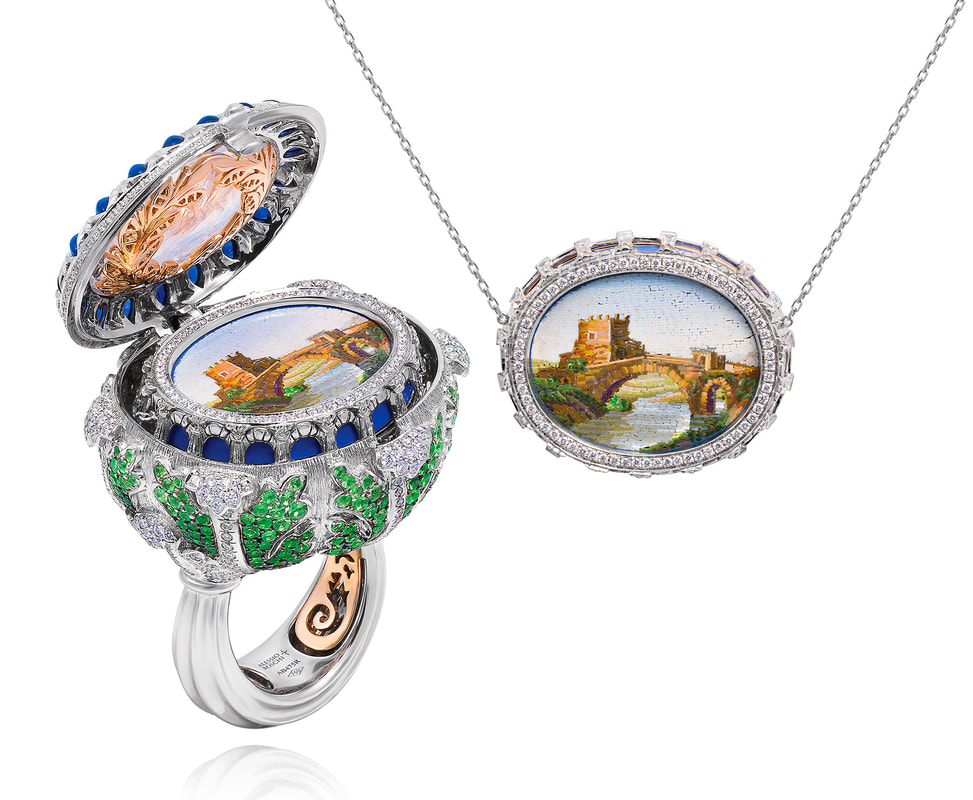
Taking months to complete, the 18K “Narcissus Bridge” ring features an 1820s antique micro-mosaic center of the Ponte Nomentano, accented with tsavorites, sapphires, sillimanite and round, rose-cut and tapered diamonds.
|
On a more serious note, Alessio makes his feelings known about the dangers of climate change with his depiction of polar bears. And, on this subject, he recently participated in a partnership with Vogue Italia, curator of “The Protagonist,” an exhibition of sustainable fine jewelry featured at a Christie’s event in New York in December 2018. The central element of this exhibition was the use of the sustainable tagua seed.
Alessio used the ivory-like tagua seed in his “Melting Arctic” ring, which he hopes will raise awareness of global warming and the effect it has on all living creatures, especially polar bears. A white-topaz domed “iceberg” sits atop the white gold ring that is accented by gold pieces in the shape of icicles and snowflakes, along with white diamonds and Paraiba tourmaline, enhanced by moonstone water droplets. In true Alessio Boschi style, a secret cabochon moonstone activates the opening of the iceberg, revealing a polar bear family carved from tagua seeds sitting on the melting icebergs of lapis lazuli and druzy that separate the mother polar bear from her cubs. The Thalassa collection, named after the Greek word for “sea,” captures life in the world’s oceans. From bejeweled sea anemones and urchins evoking the multi-colored shades of the coral reef to a series of playful baroque pearl and gemstone fish, Alessio draws inspiration from the marine world. Thanks to hidden movements, the jewels appear to be carried along by the tides. Many creations also have an element of surprise in their delicate engravings and handcrafted details. The designer’s “activist” side is also seen in a very prominent jewel in the Thalassa collection that displays his concern for the survival of the "Great White Shark," and the horrible shark-finning practices that are destroying these magnificent creatures. “The spark of creation for the Great White began when I found an extraordinary silver-blue Australian South Sea Keshi pearl in the shape of a shark’s face, with a recessive bump that looks as though its mouth is opening. After much research, we finally found several pearls for the shape, color and quality to reproduce the shark’s fin,” he reminisces. The 6-inch palladium and 18K gold brooch has matching earrings that are transformable from shoulder dusters to bejeweled shark fin studs, adorned with micro chains decorated with baby blue akoya pearls and dangling aquamarines. And, of course, the shark holds a signature surprise. “The gallery on the belly allows us to observe marine life: octopus, seahorse, starfish, shells, fish, sea anemones, squid, seaweed, crab and different coral structures,” he explains. “Then, by putting a fingernail on a hidden little knob, the gallery opens to reveal a precious space containing the earrings.” The most playful collection is undoubtedly Surprise Me. “We decided to delight and surprise with little bejeweled gift boxes in three different shapes: a cylindrical one reminiscent of vintage hat boxes, a delicate sphere, and the traditional square one.” Even in these miniatures, details reign supreme. Once the jewel is opened, a quivering message is revealed. The collection features rings, pendants and chandeliers earrings, all decorated with ribbons and bows. Among his prolific offerings of original, innovative and remarkable pieces, one stands out as truly astounding, "The Cedar" necklace. “I came up with the idea when I saw a batch of long, shard-like Panjshir emerald crystals and immediately thought of the needles on a pine tree,” he recalls. No one had ever used emeralds as “needles,” but he rose to the challenge—and the challenges were many. First was finding enough of the crystals. Second was how to mount the stones so that they remained mobile. Here, the elegant and ingenious answer was to design a special miniature cap with a spring that fixed the crystal to the branch, thus creating the effect that the pine needles trembled on the branch. The silver cap was then specially coated with a compound to make it green. The third challenge was to make the necklace look like an actual tree branch. The solution was to use the special Japanese mokume-gane metalworking technique that mixes layers of metals. “It took three months of experimentation to obtain the right alloy for each of the layers, nineteen in all,” he describes, adding that he decided on a combination of 14K pink gold, 18K white gold, 18K yellow gold, palladium and 925 silver. The final step was to find an acidic solution that dissolved the silver, leaving a vein-like structure in the contrasting colors of the tree bark. The orange pinecones were created using a mosaic of small specialty-cut spessartites, fixed together. Inside the necklace, a system of electric wires, connected to LED lights with changeable micro batteries (like those used in acoustic devices), allowed the pinecones to light up, gradually changing their intensity. A brilliant and illuminating work of wearable art, “The Cedar” necklace and matching earrings were sold to a collector in June 2018 after being shown at BaselWorld. While he loves all stones, Alessio admits that he has a preference for unusual gems, even those that are not considered “precious,” but that are beautiful, such as rutilated quartz and cats-eyes. He also has a fondness for opals and their ever-changing colors, as well as Paraiba tourmaline “especially the Brazilian stones since they remind me of the blue-green of the ocean.” A couple of years ago, Alessio commissioned amazing micro-mosaics from Rome’s pre-eminent artists, such as Cesare and Nicoletta under the direction of Francesca and Camilla of the prestigious Rome-based brand, Le Sibille. They created the remarkable miniature "paintings" in several of Alessio's masterpieces. One is in the "Romeo and Juliet" ring; others are featured in the spectacular and award-winning ”Homage to the Renaissance” set. "I must also mention my collaboration with Maestro Roberto Grieco, a micro-mosaic magician. He also uses an 'antique Roman polishing' technique, a unique final touch for which he stands above all others." As a tease for future creations, Alessio mentions the up-coming unveiling of his "Medusa" ring that offers an extraordinary artistic portrait, hidden below a precious coffer, embellished with a large flat diamond, "which suggests the reflection of the shield of Perseus." The designer also uses antique 19th-century micro-mosaics, “which are opening new roads in design.” One of these roads is seen in the Greek mythology inspired “Narcissus Bridge” collection, conjuring the story of Narcissus who fell in love with his own reflection in a pool of water. At the center of the piece is an 1820s micro-mosaic depicting the bridge. When the top of the ring is opened, the mosaic can be removed and worn as a pendant, leaving a mirror reflection in the base of the ring to echo the Narcissus story. Undoubtedly, many other new roads will surely open for Alessio Boschi, as this creative designer continues his passionate journey. |
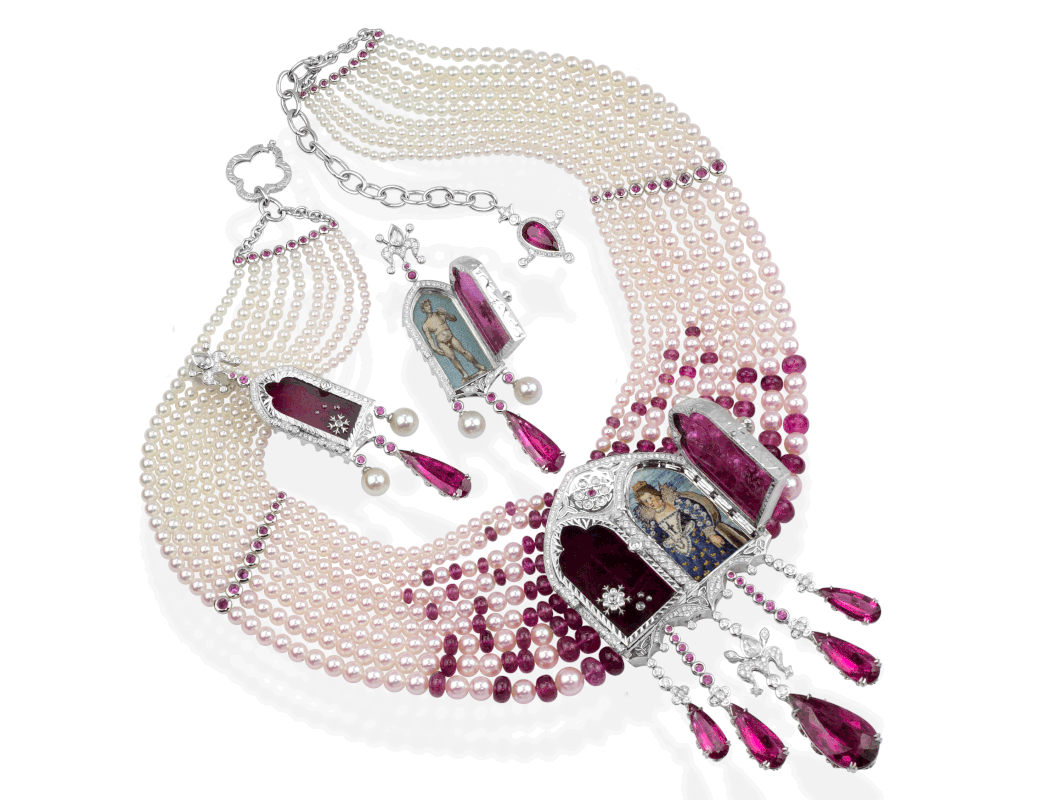
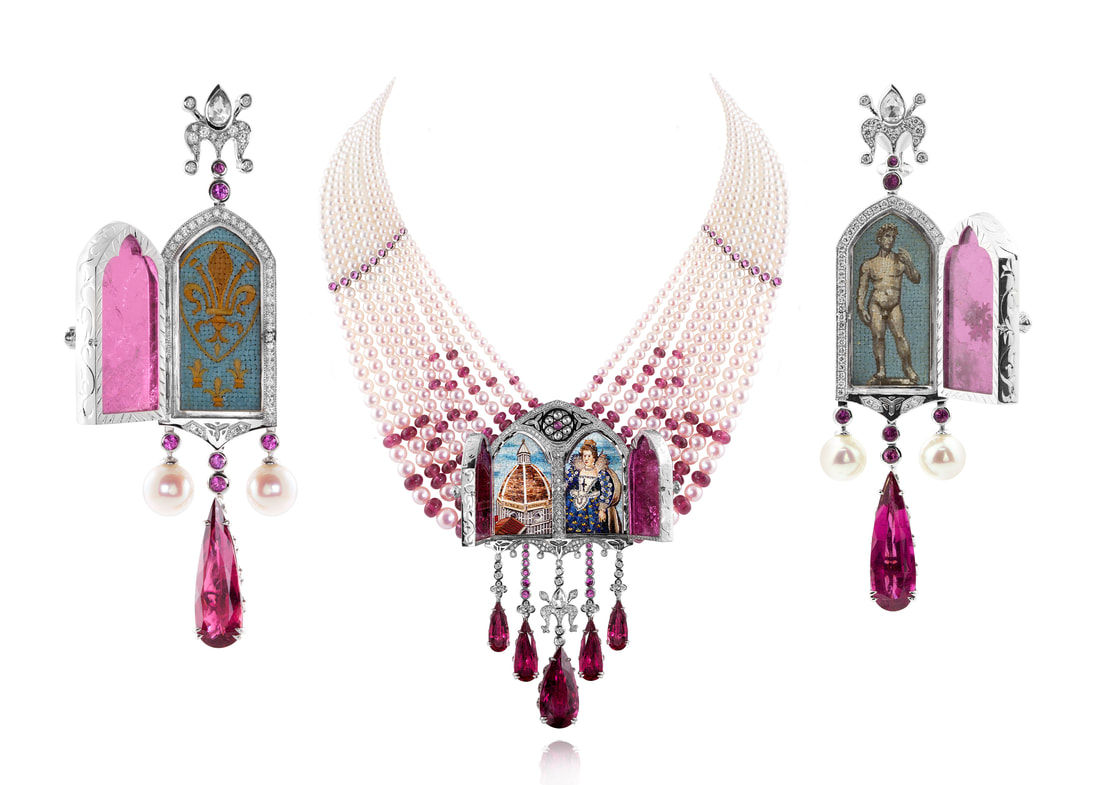
The award-winning spectacular “Homage to the Renaissance” set showcases remarkable micro-mosaics, adorned with pearls and rubellites. The earrings feature lockets that are opened to reveal intricate micro-mosaic paintings of famous Italian motifs, including Michelangelo’s David, with no detail spared. The necklace’s 18 strands of rubellite beads and pearls hold a locket featuring micro-mosaic paintings of the dome of Florence’s Cathedral of Santa Maria del Fiore and Caterina de Medici, regent of France in 1611.
|
|